
Article: Propane vs Natural Gas Outdoor Fire Pits: 2026 Guide
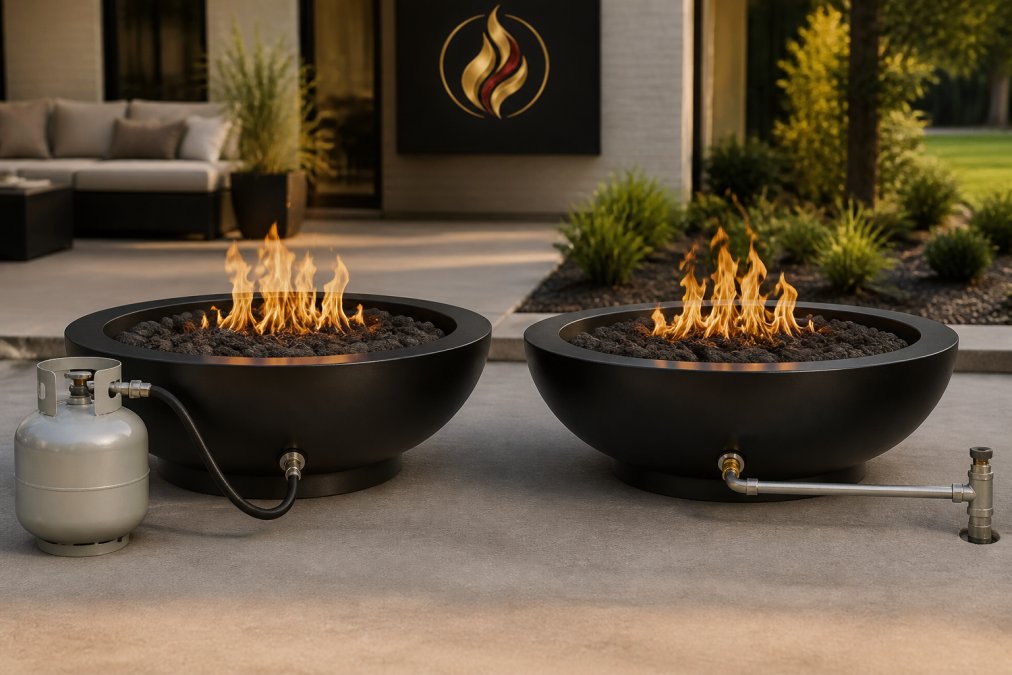
Propane vs Natural Gas Outdoor Fire Pits: 2026 Guide
Table of Contents
- Propane vs Natural Gas Outdoor Fire Pits: Quick Comparison
- Natural Gas Fire Pit Installation Requirements
- Outdoor Fire Pit Heat Output Comparison: BTU Ratings and Efficiency
- Converting a Propane Fire Pit to Natural Gas
- Portability, Flame Quality, and Climate Suitability
- Total Cost of Ownership: Fuel, Maintenance, and Long-Term Value
- Which Fuel Fits Your Outdoor Living Space?
- Frequently Asked Questions
Last Updated: September 15, 2026
Propane vs Natural Gas Outdoor Fire Pits: Quick Comparison
Comparing propane vs natural gas outdoor fire pits comes down to one trade-off: a permanent gas line delivers set-it-and-forget-it convenience, while a propane cylinder delivers placement freedom. This guide from Eternal Flame Outdoors breaks down installation, heat output, conversion feasibility, and long-term cost so you can choose with confidence.
The core distinction is simple. A propane fire pit runs on a refillable cylinder and needs no utility connection; a natural gas fire pit ties into a permanent gas line and never needs refueling. Everything else, from BTU output to permitting, follows from that single difference.
Here is the short version:
| Factor | Propane | Natural Gas |
|---|---|---|
| Fuel source | Refillable cylinder | Permanent gas line |
| Installation | Portable tank, no plumbing | Utility connection required |
| Heat output | Comparable BTU ratings | Comparable BTU ratings |
| Placement | Anywhere on the property | Within reach of the gas supply |
| Ongoing cost | Cylinder refills | Monthly utility bill |
| Best for | Renters, flexible layouts | Permanent outdoor living spaces |
Natural Gas Fire Pit Installation Requirements
Natural gas fire pit installation requirements start with a permanent gas line run by a licensed professional. This is not a DIY project, and treating it like one creates real safety exposure. What separates a smooth install from an expensive redo is planning the line before the patio is poured.
Running the Gas Line and Utility Connection
A residential plumbing or gas contractor taps your existing gas supply and runs a dedicated line to the fire feature. The work breaks into four stages:
- Load calculation. The contractor confirms your meter and existing appliances can support the fire feature's BTU demand in addition to the furnace, water heater, range, and dryer already on the system.
- Line sizing. Gas pipe is sized by BTU load and run length, not by convenience. A long run to a distant corner of the yard needs a larger-diameter pipe than a short run off a nearby meter, or the burner starves for gas and the flame runs low.
- Trenching and routing. Expect trenching if the run crosses a yard, and a shutoff valve at the appliance so the fire feature can be isolated without shutting down the rest of the house.
- Pressure regulation. A regulator at the burner keeps gas pressure within the range the ignition system and safety valve are rated for. Undersized regulators are a common cause of weak or yellow flame on an otherwise correctly sized burner.
The NFPA 54 National Fuel Gas Code governs fuel gas piping and appliance connections, and your contractor will work to it. Ventilation matters too: an outdoor burner needs open air above and around it, so avoid enclosing a fire table under a solid roof overhang. A covered pergola with open sides is generally fine; a sealed enclosure is not.

Permitting, Zoning, and Ventilation Basics
Most jurisdictions require a permit for a new gas line, and inspections typically happen before backfilling. The sequence usually looks like this:
- Apply for the permit with a description of the appliance and the proposed route.
- Rough-in inspection of the buried line before it is covered.
- Final inspection after the appliance is connected and the burner is tested.
Zoning rules can also restrict how close a fire feature sits to a property line or structure. Setback requirements vary by municipality and by whether the feature is open-flame or enclosed, so confirm both the permit and the setback with your local building department before ordering. If you are working with a designer, builder, or landscape architect, loop them in early, the gas route often needs to be coordinated with irrigation, drainage, and electrical conduit before any of it is buried.
What This Means for Propane Buyers
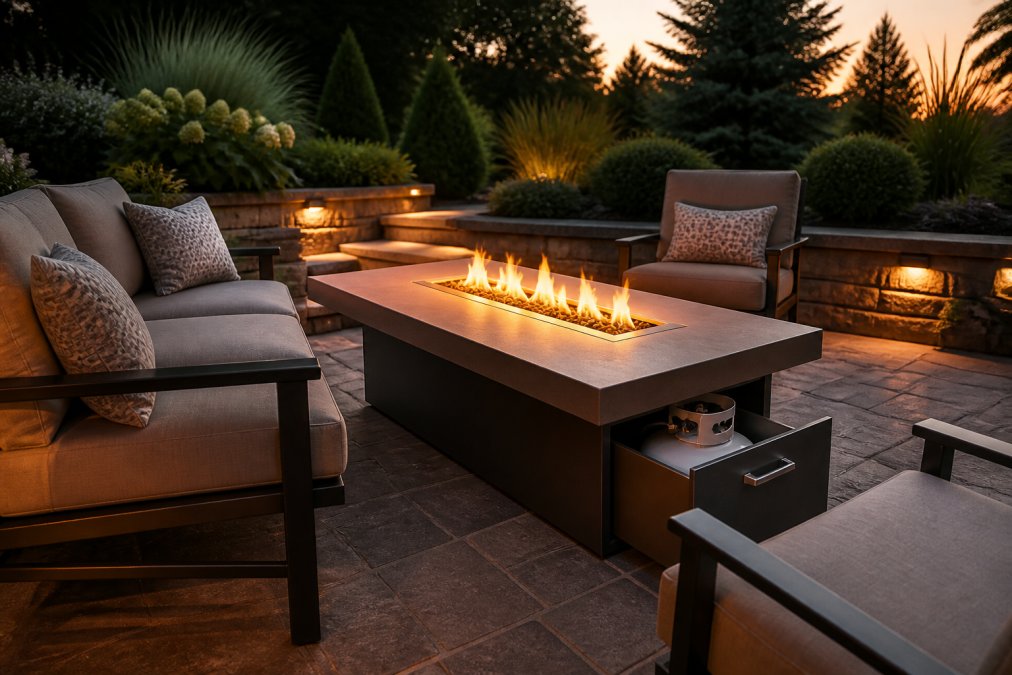
None of the above applies to propane. A propane fire table needs no utility connection, no trenching, and no gas permit in most jurisdictions, which is why it remains the faster path for renters, seasonal layouts, and anyone who does not want to open a wall or dig a trench. The trade-off is the cylinder: you handle refills, and you accept that the tank has to live somewhere, either exposed or behind a concealed tank drawer.
Outdoor Fire Pit Heat Output Comparison: BTU Ratings and Efficiency
Outdoor fire pit heat output comparison shows propane and natural gas delivering similar BTU ratings when the burner is sized correctly. The difference is not the fuel; it is the burner, the media, and how the flame is distributed.
For reference, the American Fyre Designs Contempo Propane Firetable with Tank Drawer produces 60,000 BTU on a 24-inch stainless steel linear burner, while the larger Contempo Reclaimed Wood Propane Firetable runs 65,000 BTU. Those figures represent the practical range for a residential fire table.

Three factors shape how that heat reaches you:
- Burner size and flame height determine radiant output at the seating edge.
- Media bed depth affects heat distribution; lava rock or fire glass spreads warmth and softens the flame.
- Thermal efficiency depends on wind exposure, not fuel type. A windy corner wastes heat regardless of what feeds the burner.
Gas pressure is the quiet variable. If a regulator is undersized or a line is undersized for the run length, flame quality drops and BTU output suffers even though the burner is rated higher.
Converting a Propane Fire Pit to Natural Gas
Converting propane fire pit to natural gas is technically possible on most gas appliances, but it is not a swap-and-go job. It requires a conversion kit and a different orifice sized for the fuel.
Conversion Kits, Orifice Changes, and When to Call a Pro
Natural gas and propane burn at different pressures and energy densities, so the orifice that meters gas into the burner must change. A conversion kit supplies the correct orifice, and often a new regulator and fittings.
Portability, Flame Quality, and Climate Suitability
Total Cost of Ownership: Fuel, Maintenance, and Long-Term Value
The Three Buckets
| Cost bucket | Propane | Natural Gas |
|---|---|---|
| Appliance | Similar price for comparable models | Similar price for comparable models |
| Installation | Cylinder and hose only | Contractor, permit, inspection, trenching if needed |
| Fuel | Cylinder refills on your schedule | Folds into the monthly utility bill |
| Maintenance | Burner, ignition, media, tank handling | Burner, ignition, media, occasional line inspection |
| Failure mode | Empty tank, cold-weather pressure loss | Rare line or regulator issue |
How to Estimate Your Break-Even
A practical framework, without guessing at your local rates:
What Actually Drives the Answer
The Decision Shortcut
Which Fuel Fits Your Outdoor Living Space?
Frequently Asked Questions
Which is cheaper to run: propane or natural gas fire pits?
Natural gas usually costs less per unit of heat than propane, and you never pay for tank refills or delivery. Propane can cost more per BTU, but it requires no gas line and works anywhere. Your actual cost depends on local utility rates, propane prices in your area, and how many hours you burn each month. For frequent use, natural gas often wins on operational cost; for occasional use, propane's flexibility may offset the higher fuel price.
Do I need a professional to install a natural gas fire pit?
Yes. Natural gas fire pit installation requirements include running a permanent gas line from your home's supply, which involves plumbing work, a shutoff valve, and often a permit. A licensed plumber or gas fitter should handle the utility connection and pressure regulator. Many fire tables, like The Outdoor Plus Alameda, are available in natural gas configurations, but the line itself is best left to a qualified professional to ensure safe combustion and code compliance.
Can I convert a propane fire pit to natural gas?
Converting a propane fire pit to natural gas is possible on many models, but it is not a simple swap. You typically need a manufacturer-approved conversion kit with a different orifice size and a pressure regulator rated for natural gas. Some burners and ignition systems are not convertible at all. Check your model's manual or contact the manufacturer before buying parts. If the fire pit is not rated for conversion, replacing the burner or choosing a dual-fuel model is safer.
Which fuel source provides a hotter flame for outdoor fire pits?
BTU output, not fuel type, determines how hot a fire pit feels. Propane and natural gas burners are often rated at similar BTU levels, such as 60,000 to 65,000 BTUs in many American Fyre Designs and The Outdoor Plus models. Natural gas produces slightly less heat per cubic foot than propane, so a natural gas burner may need a higher flow rate to match propane's output. Flame height and heat distribution also depend on burner design and media.
Are there safety differences between propane and natural gas fire pits?
Both fuels are safe when installed and maintained correctly. Propane is heavier than air and can pool in low areas if it leaks, so portable tanks should be stored upright outdoors. Natural gas is lighter than air and dissipates more quickly, but it requires a permanent line with a proper shutoff valve and regulator. All gas fire pits should have a safety valve, be checked for leaks annually, and never be used in enclosed spaces without ventilation.

Leave a comment
This site is protected by hCaptcha and the hCaptcha Privacy Policy and Terms of Service apply.