

Benefits of a Fire Feature in Your Backyard Water Fountain
Last Updated: November 3, 2026
Quick Summary
A fire feature in your backyard water fountain adds warmth, movement, and sound to one focal point. Water and flame create strong sensory contrast, and the flame extends use of the space into cooler evenings and across more months of the year.
- Water and flame contrast creates a multi-sensory focal point that holds attention.
- The flame warms seating areas, so guests linger longer on cool evenings.
- Gas-fueled fire elements can be enjoyed in cool weather and shoulder seasons.
- Plan gas, water, and placement early, since these drive most installation problems.
- Check local codes and clearances with your building authority before you buy.
Table of Contents
- Why Pair Fire and Water in One Backyard Feature
- 7 Benefits of Adding a Fire Feature to Your Water Fountain
- Fire and Water Feature Ideas for Different Yard Layouts
- Pros and Cons of Adding a Fire Feature to a Fountain
- Can You Add a Fire Feature to an Existing Fountain?
- Outdoor Fire Feature Safety Essentials
- Fire and Water Feature Maintenance Basics
- Choose the Right Fire and Water Feature for Your Backyard
- Frequently Asked Questions
Why Pair Fire and Water in One Backyard Feature
A fire feature in your backyard water fountain gives you warmth, movement, and sound in a single focal point.
Water and fire sit at opposite ends of the sensory spectrum. Moving water is cool, soft, and audible, while flame is warm, bright, and quiet.
The pairing also solves a practical problem. A fountain on its own is a daytime and early-evening feature, while a fire pit on its own is primarily an evening feature.
7 Benefits of Adding a Fire Feature to Your Water Fountain
Adding a fire element to an existing or planned fountain changes how the space feels, sounds, and functions. These are the benefits homeowners most often notice.
Visual Impact and Focal Point
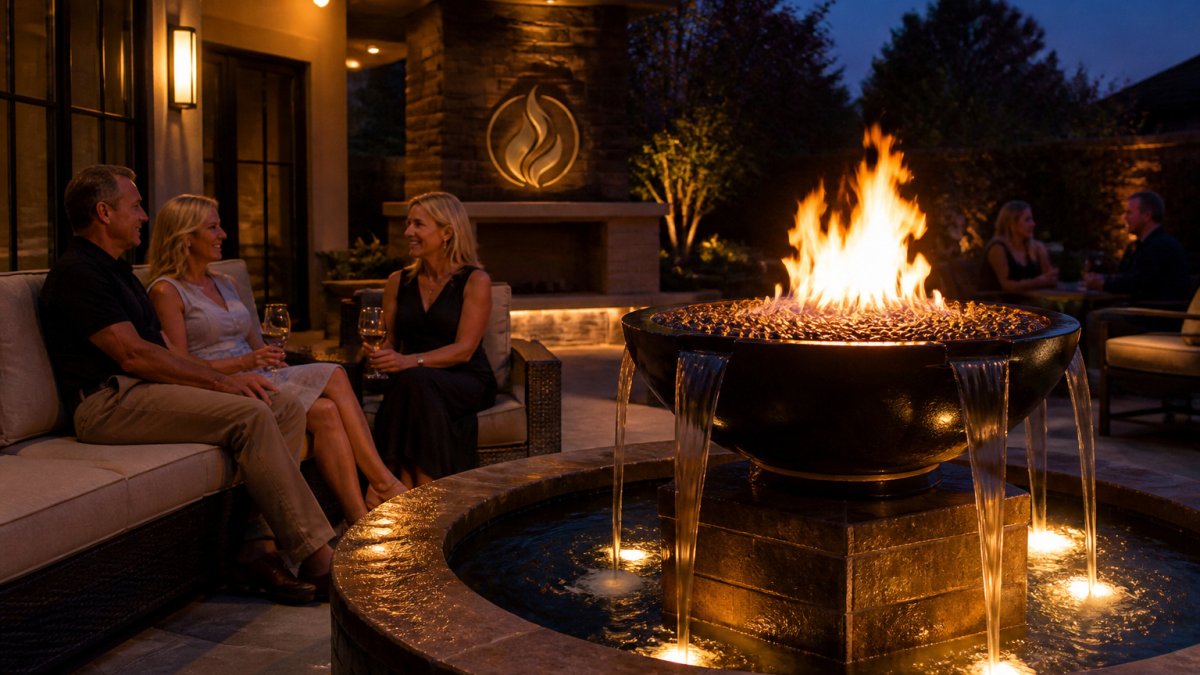
A fire and water feature anchors a yard in a way a fountain alone often cannot. The flame adds a second moving element, so the feature stays interesting from every angle. The Sedona Fire & Water Bowl with its 360° spill shows how water can cascade around a fire bowl for a dramatic, continuous display.

Ambiance, Sound, and Psychological Comfort
The sound of flowing water is one of the most widely appreciated background sounds in outdoor design, and the flicker of fire adds a calming visual rhythm. Together they help make a patio feel more like a retreat and less like an open yard.
Extended Use Into Cooler Evenings
Flame radiates heat, which makes the seating area around the feature usable when the evening air turns cool. Guests tend to linger longer near warmth, which extends the hours your outdoor space gets used.
Temperature Balance
Fire and water are complementary in climate terms: the flame warms the immediate area while the moving water adds a gentle cooling presence. The effect is subtle, but it makes the zone around the feature comfortable across a wider range of conditions.
Year-Round Versatility
Gas-fueled fire elements can be enjoyed in cool weather, shoulder seasons, and on mild winter nights.
Design Flexibility
Fire and water features come in square and round forms, which lets them suit a range of landscapes. A feature can be a standalone centerpiece or part of a larger hardscape plan.
Built-In Gathering Spot
A fire and water feature gives people a natural place to stand, sit, and talk. That makes it easier to design seating and traffic flow around a single, purposeful centerpiece rather than scattered pieces of furniture.
Fire and Water Feature Ideas for Different Yard Layouts
The right design depends on how your yard is shaped and how you plan to use it.
For a small backyard, a compact round bowl set at the center of a paver patio keeps the feature from crowding the space. The Sedona Fire & Water with Round Legs adds architectural height without expanding the footprint much.

For a pool or poolside setting, a fire and water element can frame the water view and provide warmth for evening swimmers.
For a formal garden or courtyard, a symmetrical arrangement with matching planters or lighting reinforces the sense of order.
Pros and Cons of Adding a Fire Feature to a Fountain
Before committing, weigh both sides.
Pros
- Creates a strong, multi-sensory focal point
- Extends evening and cool-weather use of the space
- Combines warmth, movement, and sound in one installation
- Adapts to many styles, from modern to traditional
- Gives guests a natural place to gather
Cons
- Requires a gas line or appropriate fuel supply, which affects installation planning
- Adds water-circulation and maintenance needs on top of the fire element
- Larger units carry significant cost and need suitable site preparation
- Must be placed with clearance from structures, plants, and seating
- Fire and water components need periodic cleaning and inspection
Most drawbacks come down to planning. Addressing gas, water, and placement early avoids most problems.
38" Sedona Fire & Water Bowl 360° Spill →
Can You Add a Fire Feature to an Existing Fountain?
In many cases, yes, but the answer depends on the fountain's construction and its plumbing. A retrofit is simplest when the fountain has a basin large enough to accommodate a fire bowl and when a gas line can reach the planned location.
If you are planning a retrofit, a self-contained unit such as the Atlas Fire & Water Self-Contained Unit integrates the fire and water components into one assembly.

Outdoor Fire Feature Safety Essentials
Safety is the most important consideration for any outdoor fire feature, and a fire-and-water unit adds a wrinkle most guides ignore: you are managing an open flame and a recirculating water system in the same footprint. The two systems interact, so the safety plan has to account for both.
Clearances and Placement
Manufacturers publish minimum clearances from combustible construction, overhangs, and sidewalls, and those numbers vary by unit and by burner size. Treat the published clearance as the floor, not the target.
Watch out: clearances measured to a deck railing or pergola post are measured to the nearest combustible surface, not to the center of the feature, a mistake that shows up after installation, when moving the unit is no longer simple.
Gas Supply and Connections
A natural gas or propane connection should be installed and leak-tested by a licensed professional. Confirm the line is sized for the burner's input rating, because an undersized line produces a weak, sputtering flame that owners often misdiagnose as a burner defect. Install a manual shutoff valve at a reachable location, and know where it is before the first lighting. For propane, keep cylinders upright, out of direct sun, and away from the burner housing.
The Water Side of the Safety Equation
Water and electricity are the pairing that deserves the most caution. Pumps, lighting, and any autofill or drain controls should be on circuits protected by ground-fault circuit interrupter (GFCI) protection, and all electrical connections should be rated for wet locations. Keep the pump intake clear so water does not overflow onto the burner or the surrounding hardscape. If the water level drops and the pump runs dry, shut the system down rather than topping off while it operates.
Codes, Permits, and the Authority Having Jurisdiction
This is the part most articles skip. Outdoor fire features are governed locally, and requirements vary widely by municipality. Before you buy, check with your local building department, often called the authority having jurisdiction (AHJ), about permit requirements, setback distances from property lines and structures, and any burn restrictions. Many jurisdictions regulate open burning and may restrict certain fuel types or require specific clearances.
Operating Habits That Prevent Most Incidents
- Never leave a flame unattended, and shut off the gas supply when the feature is not in use.
- Keep children and pets at a safe distance while the feature is operating, and teach guests where the shutoff is.
- Let the burner and fire media cool completely before servicing or refilling.
- Keep the area free of dry leaves, mulch piles, and other combustibles that wind can carry toward the flame.
- Inspect hoses, fittings, and the ignition system at the start of each season.
Consult your local building authority and a licensed installer for requirements specific to your property. This guide is general information, not installation instructions or a substitute for local code review.
Fire and Water Feature Maintenance Basics
A fire-and-water feature has two systems that need care, and they affect each other. Water splash and humidity reach the burner and ignition components, while heat and ash sit inches from the pump and basin. A maintenance routine that treats them as one unit lasts longer than one that services each in isolation.
Water Quality and Circulation
Keep the basin clean and the water level consistent. Autofill and drain components reduce the guesswork, but check them periodically rather than trusting them blindly. Clear debris from pump intakes and skimmer areas, because a clogged intake strains the pump and can cause overflow near the burner. In hard-water areas, mineral scale builds on spillways and bowl surfaces; wipe them down before scale sets.
Fire Components
Inspect burners, orifices, and ignition systems at the start of each season and after any period of disuse. Clean fire media according to the manufacturer's instructions, glass and lava rock both trap dust and debris over time. Check that the flame is even and the color is consistent; a yellow, lazy flame or a smell of gas can indicate a blocked orifice or a supply problem that needs a professional.
Seasonal Winterization
This is where dual-element features need the most attention, and where most generic maintenance advice falls short. In freezing climates, water left in the pump, lines, and basin can crack components. Drain the water system per the manufacturer's instructions, disconnect or protect the pump, and cover the basin to keep ice and debris out.
A Simple Seasonal Checklist
| Timing | Water system | Fire system |
|---|---|---|
| Start of season | Clean basin, check pump and autofill, clear intakes | Inspect burner and ignition, test flame, check fittings |
| Monthly in use | Check water level and clarity, remove debris | Clear media of debris, confirm even flame |
| Before first freeze | Drain lines and pump, cover basin | Shut off gas, protect ignition and burner |
| Spring | Refill, test circulation, check for winter damage | Leak-test connections, test ignition before first use |
Following the manufacturer's maintenance schedule is the most reliable way to protect your investment. When in doubt about a gas or electrical component, call a licensed professional rather than servicing it yourself.
Choose the Right Fire and Water Feature for Your Backyard
Start with three questions: how much space you have, what fuel and water access your site supports, and how you plan to use the area. A small yard and a resort-style courtyard call for different sizes and configurations. A site without an existing gas line may need planning before any design decisions.
Our team at Eternal Flame Outdoors can help you compare options and think through layout and scale. If you are also deciding whether a smaller footprint suits your space, our guide on 7 ways to integrate water features in small spaces offers useful ideas, and whether smokeless fire pits are good for small backyards covers another piece of the decision.
Frequently Asked Questions
Should I leave my outdoor water fountain on all the time?
Many homeowners run a fountain during the day and in the evening, then switch it off overnight to reduce noise and wear. Continuous operation is generally what the water circulation system is designed for, but it helps to check the manufacturer's guidance for your specific model. Pairing the fountain with an autofill and a 24-hour circulation pump, as found on some Eternal Flame Outdoors fountain packages, supports reliable continuous operation. If you add a fire feature, plan to run the flame only while someone is present and turn it off when you go to bed.
Do outdoor water fountains use a lot of electricity?
Electricity use depends on the pump size and how many hours the fountain runs. A circulation pump is the main draw, so running a fountain on a set schedule rather than around the clock keeps energy use modest. Gas-fueled fire elements use natural gas or liquid propane instead of electricity for the flame, though an electronic ignition may draw a small amount of power. Check the specifications of any fountain before you buy to compare its water flow and power needs.
Are fire-and-water features safe to use?
Fire and water features are safe when they are installed and operated according to the manufacturer's instructions and local codes. Gas connections should be made by a qualified professional, and the feature should sit on a stable, level surface away from overhanging branches, structures, and combustible materials. Keep children and pets supervised around the flame, and never leave a lit feature unattended. Regular inspection of burners, fire glass, and gas lines helps catch problems early.
Ready to create a fire and water focal point for your backyard? Browse our curated selection of fire and water features, or contact the Eternal Flame Outdoors team for personalized guidance on the right design for your space.




Leave a comment
This site is protected by hCaptcha and the hCaptcha Privacy Policy and Terms of Service apply.