
7 Ways to Integrate Water Features in Small Spaces
Last Updated: October 31, 2026
Quick Summary
To integrate water features in small spaces, measure your footprint, height, and clearance first, then choose a style that grows upward instead of outward, such as a wall-mounted fountain, urn, or planter fountain. Confirm power, water, and a level base before installation.
- Keep at least 36 inches clear along a main walking route so the fountain never blocks the path.
- Allow roughly 24 to 36 inches between a fountain and the nearest chair to keep splash off guests.
- A plug-in recirculating fountain takes about 2 to 3 hours to install at beginner to moderate difficulty.
- Check the water level weekly, since a pump that runs dry overheats and can burn out.
- Drain the feature and store the pump indoors before the first hard freeze in cold climates.
Table of Contents
- How to Integrate Water Features in Small Spaces: The Basics
- Small Patio Water Feature Ideas That Fit Tight Footprints
- Where to Place a Garden Fountain for Maximum Impact
- Compact Outdoor Fountains: Wall-Mounted, Urn, and Planter Styles
- Step-by-Step Installation for a Small Water Feature
- Small Fountain Maintenance and Seasonal Care
- Choosing the Right Water Feature for Your Space
- Frequently Asked Questions
How to Integrate Water Features in Small Spaces: The Basics
A small yard does not have to feel like a small yard. Learning how to integrate water features in small spaces comes down to three things: honest measurements, a realistic plan for water and power, and picking a style that uses height instead of floor area.
Here is the core idea most guides skip. In a tight yard, a water feature is not decoration. It is a focal point. Get the placement right and the whole space reads bigger. Get it wrong and you have created an obstacle.
Measure First: Footprint, Height, and Clearance
Start with a tape measure, not a catalog. Before you shop, write down four numbers:
- Available footprint: the floor area you can give up without blocking a walkway
- Height: how tall a feature can stand before it crowds a wall or window
- Clearance: the walking path you must keep open, usually at least 36 inches for a main route
Small patio water feature ideas live or die on these numbers. A fountain that fits the footprint but blocks the only path to the grill is a mistake you will notice every single day.
Water, Power, and Drainage Requirements
Most compact fountains run on a recirculating pump. Water lifts from a hidden basin, spills over the top, and falls back in. You top off for evaporation, and that is it.
Plan for three connections:
- Power: a GFCI-protected outdoor outlet within reach of the pump cord
- Water: a hose bib nearby for refills, or a self-contained basin you fill by hand
- Drainage: a level, stable base and a plan for splash and overflow
Watch out: skipping the GFCI outlet and running a standard extension cord across a wet patio is the most common safety mistake we see. Have an electrician add the outlet before the fountain arrives.
Small Patio Water Feature Ideas That Fit Tight Footprints
The best small patio water feature ideas share one trait: they grow upward, not outward.
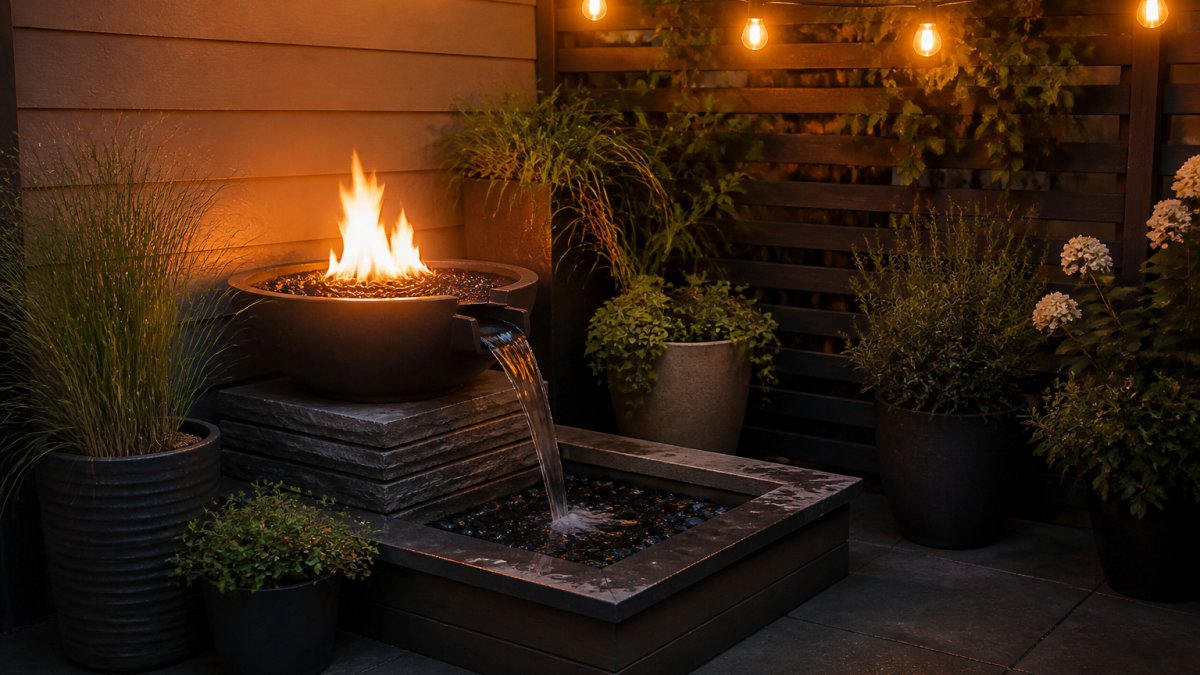
Here are seven directions that work in tight footprints:
- Wall-mounted fountain or water blade: mounts to a wall or fence, zero floor space
- Urn fountain: a classic vessel with a recirculating pump, roughly the footprint of a planter
- Planter fountain: water spills from a potted arrangement, doubling as greenery
- Pedestal bird bath: an ornamental bird bath adds height and moving water for wildlife
- Rock bubbler: a natural rock feature with water bubbling up through the stone
- Narrow trough or rill: a long, thin channel that draws the eye down a narrow yard
- Fire and water bowl: a statement piece that combines flame and a 360-degree spill
Each one solves the same problem in a different way. The right pick depends on your wall space, your power access, and how much sound you want.
Where to Place a Garden Fountain for Maximum Impact
Placement decides whether a garden fountain reads as a designed focal point or an afterthought. In a small space, the margin for error is tighter: a feature that blocks a path or splashes a walkway becomes a daily annoyance. The strongest spot is usually where the eye lands when you walk outside, or where you sit and look. Put the fountain there, then build the rest of the layout around it.
The Clearance Numbers That Matter
Before you commit to a spot, check these distances:
- Main walking route: keep at least 36 inches clear. A fountain that narrows the only path to the grill is a mistake you will notice every day.
- Seating: allow roughly 24 to 36 inches between a fountain and the nearest chair so splash does not reach guests.
- Walls and fences: leave a few inches behind a wall-mounted feature for the basin and tubing, and keep spouts far enough out that water does not climb the wall.
Placement Rules That Hold Up in Practice
- Sit where you will sit. Test the view from your chairs, not from the door.
- Anchor a corner. A fountain in a bare corner softens hard lines and fills dead space.
- Use it to mask noise. Moving water near a street or neighbor's patio covers traffic and conversation.
Sightlines and the Focal-Point Test
A small space reads larger when the eye has one clear destination. Stand at the door you use most and look out. The first thing you see should be the feature, not a bare wall or a storage box. If the view is blocked, move the feature or remove the obstruction. A fountain placed on axis with a seating area or a main window does more for the space than one tucked into a corner you never look at.
Safety and Access
- Slip risk: keep splash off pavers and steps. Add pebbles or a splash guard where water lands.
- Electrical protection: the pump must connect to a GFCI-protected outlet. Do not route cords across walkways.
- Children and pets: a basin with standing water needs supervision or a barrier. Choose a feature with a covered reservoir if young children use the space.
For a broader look at tying the fountain into the whole layout, our guide on how to design a small backyard oasis walks through the full plan.
Compact Outdoor Fountains: Wall-Mounted, Urn, and Planter Styles
Compact outdoor fountains fall into a few clear families, and each suits a different kind of small space. Matching the style to your wall, floor, and sightlines is the fastest way to narrow the field.
Wall-Mounted Fountains and Water Blades
A wall-mounted fountain is the most space-efficient option available. It hangs on a wall or fence and uses no floor area at all. A wall water blade pushes a smooth sheet of water into a basin below, which gives you the sound and movement of a waterfall in a footprint you barely notice.
These work best on a solid wall or a reinforced fence, with the basin set directly below the spout. You can browse waterfalls and fountains to see how these look in a real setting, or view the Paradise Fall Waterfall for a compact cascading option. If you want the same effect after dark, the Paradise Fall LED Waterfall Rainfall adds integrated lighting to the falling water.


Urn Fountains, Bubbler Bowls, and Planter Fountains
Urn fountains and decorative bubblers bring a sculptural element to a small garden. An urn fountain is a self-contained vessel with a hidden pump, so it needs only a level base and an outlet.
38" Sedona Fire & Water Bowl 360° Spill →
Planter fountains blend water and greenery in one footprint, which is a smart move when floor space is tight. A pedestal bird bath is the simplest version of this idea: a raised basin with moving water that draws birds and adds height without eating patio space.
Step-by-Step Installation for a Small Water Feature
Most guides stop at inspiration. This section walks through the actual setup so you can act on it. The steps below cover a plug-in, recirculating fountain on a patio or in a garden bed. In-ground basins and hardwired features add steps, but the sequence is the same.
Total time: about 2 to 3 hours for a plug-in fountain, longer if you add an outlet or an in-ground basin Difficulty: beginner to moderate
What you'll need:
- Tape measure and a 4-foot level
- Compacted gravel or paver base
- GFCI-protected outdoor outlet within cord reach
Before You Dig: Confirm the Three Connections
A compact fountain needs three things within reach: power, water, and a level base. Confirm all three before the box arrives.
- Power: the pump cord must reach a GFCI-protected outdoor outlet. Do not run a standard extension cord across a wet patio. If no outlet is close, have an electrician add one first.
- Water: a hose bib nearby makes refills easy. A self-contained basin you fill by hand works too, but plan for more frequent top-offs.
- Base: the feature must sit level. An unlevel base makes water spill unevenly and stresses the pump.
The Installation Sequence
- Confirm the location. Check the footprint, clearance, and sightlines from your seating area. Keep the feature off the main walking route.
- Prepare a level base. Set pavers or a compacted gravel pad. Check level in two directions, not one.
- Set the basin or reservoir. For an in-ground feature, dig and level the basin so the rim sits flush with the ground.
- Place the pump. Follow the manufacturer's instructions for positioning and water depth. Most pumps need to sit fully submerged.
- Connect the tubing and feature. Route tubing to the spout or bowl and check every connection before filling.
- Fill and test. Fill the basin, plug in, and watch the water flow. Adjust the pump until the spill is even.
- Check for splash. Add river rock or pebbles around the basin to catch splash and hide the reservoir edge.
- Add plants and lighting. Surround the feature with plants and low-voltage lighting to finish the look.
Commissioning and Troubleshooting
Run the feature for a full cycle before you call it done. Watch for these common issues:
- Uneven spill: the base is not level or the pump is too strong. Re-level the base, then adjust the pump flow.
- Splash outside the basin: add pebbles or a splash guard, or reduce pump speed.
- Pump noise or cavitation: the water level is too low. Top off the basin.
Expected result: an even sheet or spill of water with no dry spots, no overflow, and a dry walking path. Once it runs clean for a full cycle, you are ready to plant and light around it.
Small Fountain Maintenance and Seasonal Care
Small fountain maintenance is mostly a weekly habit, not a project.
A simple routine:
- Weekly: skim debris, check the water level, and remove leaves from the pump intake
- Monthly: clean the pump filter and wipe the basin walls
- Seasonally: drain and deep-clean, then store or cover the feature before freezing weather
Watch out: letting the basin run low is the fastest way to burn out a pump. A pump that runs dry overheats. Check the level before you leave for a weekend.
In cold climates, drain the feature and store the pump indoors before the first hard freeze. Trapped water expands and can crack stone, concrete, or ceramic.
Choosing the Right Water Feature for Your Space
The right water feature is the one that fits your measurements, your power access, and the sound level you want. Use this quick reference to match the space to the style.
| Space situation | Best feature type | Why it works |
|---|---|---|
| Narrow side yard, wall available | Wall-mounted fountain or water blade | Uses no floor space |
| Small patio corner | Urn fountain or fire and water bowl | Compact footprint, strong focal point |
| Garden bed with greenery | Planter fountain or rock bubbler | Blends water with planting |
| Open lawn edge | Pedestal bird bath | Adds height and draws wildlife |
| Long narrow yard | Trough or rill | Draws the eye down the space |
If you want flame and water in one feature, a fire and water bowl makes a dramatic centerpiece. The 38" Sedona Fire & Water Bowl 360° Spill is a handcrafted option designed for fountain applications, with a 360-degree spill that creates movement and sound from every angle.

Best for: homeowners who want a sculptural focal point. Skip if: you need a fully self-contained plug-in unit with no recirculating system.
Frequently Asked Questions
What water features work best in small spaces?
Compact designs that move water vertically rather than spreading outward tend to work best. Wall-mounted fountains, wall water blades, urn fountains, pedestal bird baths, and planter fountains all keep a tight footprint while adding movement and sound. A sculptural bowl with a 360-degree spill, like the Sedona Fire & Water Bowl, can serve as a standalone focal point in a courtyard or entry area when paired with a properly sized recirculating water system. Measure your available width and depth before shopping so the feature fits without crowding walkways.
Where should you place a garden fountain in a small yard?
Place it where you will see and hear it most: near a seating area, along a sightline from a window, or as a focal point at the end of a narrow path. Keep it away from tight walkways to limit splash on paving, and set it back from property lines so the sound reads as ambience rather than noise. In a small garden, a corner placement often works well because it uses space that is hard to furnish and lets surrounding plants soften the base.
Do small water features need plumbing?
Most compact fountains run on a recirculating pump rather than a direct plumbing line, so the same water cycles through the basin and only needs topping off as it evaporates. You will need a power source nearby, either a standard outdoor outlet or a solar pump for sun-exposed spots. Larger sculptural pieces may specify a water connection and flow rate, so check the product listing before planning the layout. Drainage matters too: plan for overflow and a way to empty the basin for cleaning.
How do you keep a small fountain from splashing and losing water?
Splash control comes down to pump size, water level, and placement. Match the pump to the feature's recommended flow rate, keep the water at the fill line so the pump does not gulp air, and avoid installing a spilling feature where wind funnels through. In windy spots, a lower, gentler spill or a covered urn design loses less water. Check the level weekly in summer, since evaporation and splash are the two main reasons a small fountain needs constant topping off.
A small space still has room for real drama. The trick is choosing a feature that fits your measurements and placing it where the eye lands. Eternal Flame Outdoors carries a curated selection of premium fire and water features from trusted brands, backed by nationwide delivery and manufacturer warranties. Our team can help you match a feature to your footprint and sightlines before you buy. Get started with Eternal Flame Outdoors and turn a tight patio into a place people gather around.



Leave a comment
This site is protected by hCaptcha and the hCaptcha Privacy Policy and Terms of Service apply.