
7 Steps to Choose the Right Patio Heater Heat Output
Last Updated: October 29, 2026
Quick Summary
Patio heater heat output should be sized to the seating area, not the whole patio. Multiply the usable square footage by about 20 to 30 BTUs per square foot, then add 10 to 15 percent for partly open patios or 20 percent or more for fully open, windy spaces.
- Measure only the occupied seating zone, not the entire patio footprint.
- Use roughly 20 to 30 BTUs per square foot as a starting planning range.
- Add 10 to 15 percent for partly open patios and 20 percent or more for windy ones.
- Convert electric wattage to BTUs by multiplying watts by 3.41 before comparing fuel types.
- Size for a typical evening and add a second heater later if needed.
Table of Contents
- Why Heat Output Matters More Than Heater Style
- How Many BTUs for a Patio Heater Do You Need?
- Step 1: Measure Your Usable Seating Area
- Step 2: Calculate Heat Output With a Patio Heater Sizing Calculator
- Step 3: Adjust for Wind, Openness, and Shelter
- Gas vs. Electric Patio Heaters: Comparing Output and Operating Cost
- Planning Your Patio Heater Coverage Area and Placement
- Choose Your Heater and Start Planning Your Outdoor Warmth
- Frequently Asked Questions
Why Heat Output Matters More Than Heater Style
Choosing a patio heater starts with one number: heat output. Style, finish and fuel type all matter, but a heater that cannot warm your seating area will leave your guests reaching for jackets.
Heat output is usually measured in BTUs per hour, or in watts for electric models.
Watch out: buying the most powerful heater you can afford often leads to uneven warmth and wasted fuel. Size the heater to the space first, then choose the style you like best.
How Many BTUs for a Patio Heater Do You Need?
For most outdoor seating areas, a common planning range is roughly 20 to 30 BTUs per square foot of usable space. Smaller, sheltered patios often need less, while open, windy spaces often need more. Treat these figures as a starting point rather than a fixed rule.
A rough guide by space size:
- Small patio (under 100 square feet): A single compact heater in the lower BTU range is often enough.
- Medium patio (100 to 200 square feet): One mid-range heater, or two smaller units placed to overlap.
- Large patio (over 200 square feet): Multiple heaters spaced for even coverage rather than one very large unit.
Your climate changes the picture. Homes in cooler regions with frequent wind will generally need more output than homes in mild climates.
Step 1: Measure Your Usable Seating Area
Start by measuring the area where people will actually sit, not the full footprint of the patio. A large patio with a small dining set in one corner only needs heat for that corner.
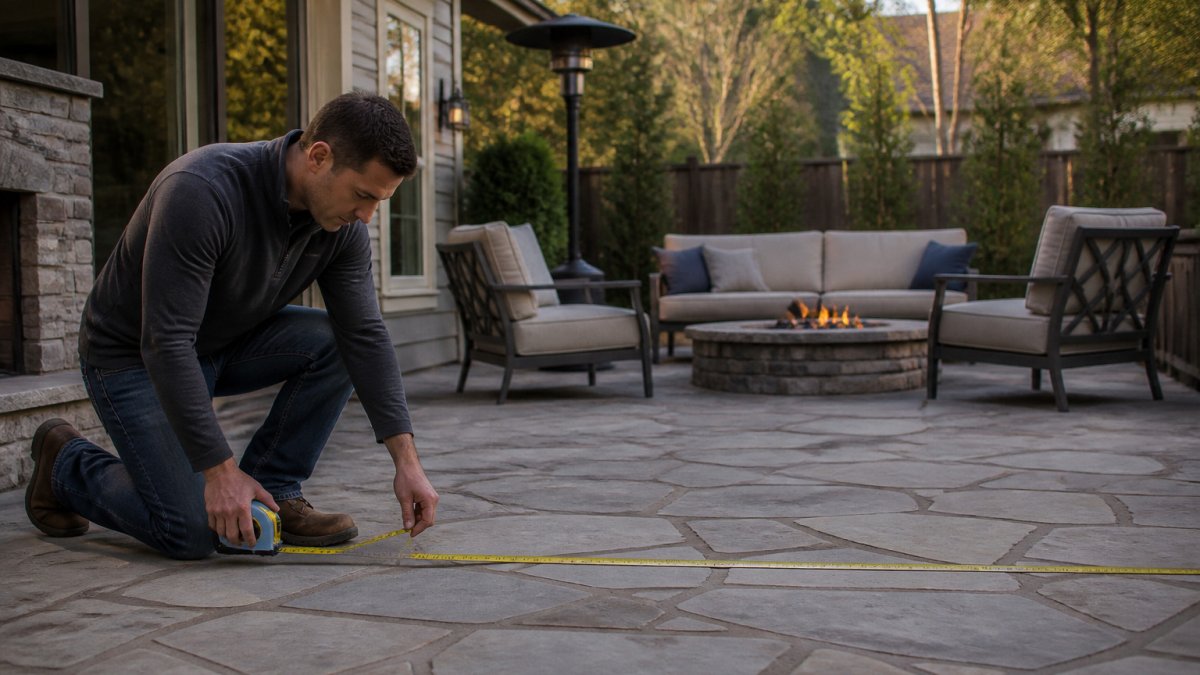
Follow these steps:
- Measure the length and width of the seating zone in feet.
- Multiply length by width to get square footage.
- Add a few feet of margin for chairs, walkways, and guests standing nearby.
A homeowner measuring a stone patio with a tape measure while a seating area sits in the background makes this step easy to visualize. Use your measurements as the input for the next step.
Step 2: Calculate Heat Output With a Patio Heater Sizing Calculator
Once you know your usable square footage, you can estimate the patio heater heat output you need. The basic method is simple:
Usable square feet × BTUs per square foot = estimated BTU need
That formula is the starting point every sizing guide uses. What most guides skip is the second half: turning that raw number into a realistic heater recommendation by layering in exposure, mounting height, and the number of heaters. Here is a fully worked example so you can apply the same steps to your own patio.
A Worked Example From Start to Finish
Suppose you have a 20-foot by 15-foot patio, but the dining and lounge seating only occupies a 12-foot by 10-foot zone in one corner.
- Measure the occupied zone, not the slab. 12 ft × 10 ft = 120 square feet of usable seating area. The remaining 180 square feet of patio is walkway, planting bed, and open space that does not need direct heat.
- Add a margin for chairs and standing guests. Pull the zone out by about 2 feet on the open sides. A 14 ft × 12 ft heated footprint = 168 square feet.
- Apply a BTU-per-square-foot baseline. At 25 BTUs per square foot, 168 × 25 = 4,200 BTUs per hour.
- Adjust for exposure. If the patio is partly open, add 10 to 15 percent: 4,200 × 1.15 ≈ 4,830 BTUs. If it is fully open and windy, add 20 percent or more: 4,200 × 1.25 = 5,250 BTUs.
- Match to real heater sizes. Round up to the nearest available output. A single 1,500-watt electric infrared heater delivers roughly 5,118 BTUs, which can be compared against the partly open estimate. For the windy case, two smaller heaters placed to overlap will usually feel better than one unit pushed to its limit.
Why the Occupied Zone Matters More Than Total Square Footage
A 400-square-foot patio with a 100-square-foot conversation area does not need four times the heat of a 100-square-foot patio. Heat output is about warming people, not the concrete. Radiant heaters warm surfaces and skin within their line of sight, so the effective heated area is the zone the heater actually faces, not the full footprint of the hardscape.
When you sketch your zone, include:
- The footprint of the dining table plus the chairs pulled out.
- Any lounge seating where guests will sit for more than a few minutes.
- A buffer for people standing and talking near the seating.
What a Good Sizing Calculator Should Ask You
Many people search for a patio heater sizing calculator. Any credible tool should ask for the same inputs this walkthrough uses:
- Length and width of the occupied seating zone (not the whole patio).
- Whether the patio is sheltered, partly open, or fully exposed.
- Ceiling or mounting height if the heater will hang overhead.
If a calculator returns a single number without asking about wind, shelter, or mounting height, treat it as a rough starting point only. The adjustment step is where most real-world sizing decisions are actually made.
True Flame Infrared Heater-Hardwired →
Turning the Number Into a Heater Count
Once you have an adjusted BTU target, divide by the output of the heater you are considering:
- Target ÷ heater BTU rating = number of heaters (round up).
- If the result is 1.4, plan for two heaters and space them so their coverage overlaps slightly.
- If the result is 0.6, one heater is likely sufficient, but confirm the coverage radius reaches the far seats.
For a deeper look at how spacing and overlap affect comfort, see the placement section below. And if you would rather have someone check your numbers, you are welcome to contact our team for personalized guidance.
Step 3: Adjust for Wind, Openness, and Shelter
Wind and openness pull heat away from people. Adjust your estimate upward if your patio is exposed.
Use these general adjustments:
- Sheltered patio, walls on two or more sides: Keep your base estimate or reduce it slightly.
- Partly open patio: Add roughly 10 to 15 percent.
- Fully open, windy patio: Add 20 percent or more.
Covered patios trap heat better than open ones, but ceiling height matters too. A heater mounted too high spreads warmth thinly, so mounting height should follow the manufacturer's guidance.
Gas vs. Electric Patio Heaters: Comparing Output and Operating Cost
Gas and electric heaters can deliver comparable warmth, but they are not measured the same way, and the numbers on the label do not tell the whole story. Gas units are rated in BTUs per hour; electric units are rated in watts. For a gas option to compare against, see our wall mounted gas radiant heater. One watt equals about 3.41 BTUs per hour, so a 1,500-watt electric heater produces roughly 5,118 BTUs.
Delivered Warmth: Why Rated Output Is Not the Same as Felt Heat
A practical way to compare them on an equivalent basis:
- Match the heated zone, not the label. Compare the BTU or wattage that actually lands on your seating area, not the total output of the unit.
- Account for beam angle and mounting height. A heater mounted high spreads its output over a wider area at lower intensity; a lower mount concentrates warmth.
- Discount for exposure. On an open, windy patio, expect a larger share of gas output to be lost to the air than on a sheltered one.
Side-by-Side Comparison
| Factor | Gas Patio Heater | Electric Infrared Heater |
|---|---|---|
| Output rating | BTUs per hour | Watts (convert to BTUs at 3.41 per watt) |
| Delivered warmth | Radiant plus air heating; some loss to wind | Mostly radiant; less air loss |
| Installation | Fuel line or tank connection | Hardwired or plug-in, depending on model |
| Setup flexibility | Freestanding, wall-mounted, or overhead | Often wall- or ceiling-mounted |
| Best for | Larger open areas, high output needs, no nearby power | Quiet, clean heat in defined zones with power available |
| Ventilation | Requires clearance and ventilation per manufacturer | No combustion byproducts |
Estimating Operating Cost on an Equivalent Basis
Operating cost depends on your local utility rates and how many hours you run the heater, so compare electric and gas bills using your own rates. The method is the same for both:
- Find your delivered output in BTUs. For electric, multiply watts by 3.41. For gas, use the rated BTU input, then note that a portion is lost to the air.
- Convert to your billing unit. Electricity is billed in kilowatt-hours (kWh); divide watts by 1,000 to get kW, then multiply by hours of use. Gas is billed in therms or gallons of propane; your supplier's rate card gives the conversion.
- Multiply by your rate. kWh × your electric rate, or therms × your gas rate, gives an estimated cost per hour of operation.
- Compare cost per heated hour, not cost per unit. A lower-output heater that runs longer may cost more per evening than a higher-output unit that cycles on and off.
Matching Wattage and Voltage to Your Space
Our electric models are available in several wattages and voltages, so check the listing for the correct installation requirements before ordering.
Larger or more exposed zones usually call for a higher-wattage hardwired unit or a second heater placed to overlap.
Our hardwired infrared heater suits homeowners comparing electric output across a defined seating zone. If you are weighing both fuel types for the same patio, you can contact our team for guidance on the options.

Planning Your Patio Heater Coverage Area and Placement
Heater placement affects comfort as much as output. Radiant heaters work best when they face the seating area directly, and their coverage narrows with distance.
Keep these placement tips in mind:
- Position heaters so they overlap slightly rather than leaving cold gaps. A remote-controlled electric infrared heater with app control lets you adjust settings from your seat.
- Mount heaters at the height the manufacturer recommends for the best spread.
- Place seating within the heated zone, not at its outer edge.
Choose Your Heater and Start Planning Your Outdoor Warmth
You now have a practical process: measure the usable seating area, estimate BTUs, adjust for wind and shelter, compare fuel types on an equal basis, and plan placement for even coverage. Following these steps helps you avoid buying too little or too much heat.
Once you know your numbers, explore our full range of patio heaters or read our guide on how to choose an outdoor fireplace for a patio.
Frequently Asked Questions
Is 46,000 BTU good for a patio heater?
A 46,000 BTU patio heater is in the range many homeowners choose for medium to large outdoor spaces. Whether it suits your patio depends on usable seating area, wind exposure, and whether the space is covered. Measure your seating area first, then compare that size against the output you need. If your patio is open to wind or is quite large, you may need more output or a second heater placed to overlap coverage. You are welcome to contact our team for personalized guidance on your layout.
How much area does a 48,000 BTU patio heater cover?
Coverage depends on conditions, not just BTU rating. A 48,000 BTU unit can comfortably serve a seating group in that range, but wind, a fully open patio, or cold climates may reduce the effective area. Measure your usable seating area, then adjust for exposure before deciding whether one heater is enough or whether you need overlapping coverage from two units.
How many BTUs is good for a patio heater?
The right BTU level depends on how much usable seating area you need to warm and how exposed the space is. Small covered patios often do well with lower output, while large open patios typically need more. A practical approach is to calculate usable square footage, apply an output target per square foot, then adjust for wind and shelter. You are welcome to contact our team for personalized guidance on your layout.


Leave a comment
This site is protected by hCaptcha and the hCaptcha Privacy Policy and Terms of Service apply.