
How Do You Choose an Outdoor Fireplace for a Patio?
Last Updated: October 27, 2026
Quick Summary
Choose an outdoor fireplace for a patio by starting with how you will use the space, then deciding between a fireplace and a fire pit, and weighing gas versus wood. Narrow your options by fuel, confirm the size and clearances fit your patio, and match the style to your home's exterior.
- A fireplace has a firebox, chimney, and venting; a fire pit is an open vessel without a chimney.
- Gas starts with a switch and needs no wood hauling or ash cleanup; wood delivers crackle, smell, and radiant heat.
- Match the unit's width to the wall or corner, then protect open floor space in front of the hearth.
- Site the firebox so prevailing breezes push smoke away from seating and doors.
- The manufacturer's stated clearance to combustible materials is a minimum, not a suggestion.
Table of Contents
- Start With How You'll Actually Use the Patio
- Outdoor Fireplace vs. Fire Pit: Which Fits a Patio?
- Gas vs. Wood-Burning Outdoor Fireplace: Weighing the Tradeoffs
- Outdoor Fireplace Size and Placement on Your Patio
- Outdoor Fireplace Installation Requirements and Site Prep
- Matching the Fireplace to Your Patio's Design
- Compare Outdoor Fireplaces for Your Patio
- Frequently Asked Questions
Start With How You'll Actually Use the Patio
The right outdoor fireplace for a patio starts with one question: how will you use the space? Answer that honestly and most of the hard decisions get easier. A fireplace is a fixed anchor. It shapes traffic flow, seating, and how many people can gather comfortably. So before you shop, sketch out a typical evening: who is there, what they're doing, and where they stand. That picture narrows your options fast. For homeowners planning to host, our guide to luxury outdoor design for entertaining guests walks through layout choices that keep a crowd comfortable.
Gathering Style and Seating Arrangement
Seating drives the footprint. A fireplace built for two people reading needs far less clearance than one ringed by eight chairs. Decide whether guests face the fire in a semicircle, sit along one long edge, or move between the fire and a dining table. The fire should sit at the edge of the conversation, not in the middle of the walkway.
Ambiance, Warmth, or Both
Some patios need a focal point. Others need real heat on a cold night. Be clear about which one you want. Ambiance-first buyers can go smaller and more decorative. Warmth-first buyers need to look hard at heat output and how far that heat travels. That single distinction shapes everything below.
Outdoor Fireplace vs. Fire Pit: Which Fits a Patio?
An outdoor fireplace is a built-in or freestanding structure with a firebox, chimney, and venting, while a fire pit is an open vessel that burns without a chimney. On a patio, the difference matters more than most buyers expect. A fireplace gives you a vertical focal point, a chimney that carries smoke up and away, and a defined architectural element. A fire pit is lower, more flexible, and easier to move or replace.
Here's the tradeoff in plain terms:
- Fireplace: stronger focal point, better smoke control, fixed location, more involved installation
- Fire pit: lower profile, flexible placement, simpler setup, less smoke control
- Fireplace: pairs well with a wall or pergola
- Fire pit: pairs well with open, central seating
Neither is better. A fireplace suits a patio with a natural wall or corner. A fire pit suits an open layout where guests circle the flame.
Gas vs. Wood-Burning Outdoor Fireplace: Weighing the Tradeoffs
A gas-burning outdoor fireplace runs on natural gas or propane and starts with a switch, while a wood-burning unit burns real logs and needs a chimney and spark screens. Both belong on a patio. The choice comes down to how much work you want, what kind of fire you love, and what fuel is actually available at your home.
Gas wins on convenience. No hauling wood, no ash cleanup, and instant on-off control. Wood wins on experience: the crackle, the smell, the radiant heat that only a real fire throws. Wood also asks more of you. It needs seasoned fuel, a proper chimney, and regular ash removal.
U.S. Environmental Protection Agency guidance on wood smoke and cleaner burning is worth reading before you commit to wood, especially in areas with air-quality rules.
For a look at a gas unit, the Williams Outdoor Gas Fireplace comes in 72", 84", and 96" widths with natural gas or liquid propane configurations and several ignition options.

Fuel and Operating-Cost Comparison
| Fuel | Availability | Installation Needs | Convenience | Ongoing Cost Pattern |
|---|---|---|---|---|
| Natural gas | Requires a metered gas line at the home | Licensed gas-line run, shutoff, and permit | Switch-on, unlimited supply | Billed per therm on your utility statement; typically the lowest per-hour cost where a line exists |
| Propane | Delivered and stored in a tank on site | Tank, regulator, and line; tank sizing and refill scheduling | Switch-on, but you monitor tank level | Priced per gallon; usually higher per hour than natural gas because you buy and store fuel |
| Wood | Seasoned cordwood from a local supplier | Chimney, spark screens, noncombustible base, outside air often required | Manual lighting, ash cleanup, wood storage | Priced per cord; varies widely by region and season |
| Electric | Standard household circuit | Dedicated circuit and outlet; no venting | Switch-on, no fuel handling | Billed per kilowatt-hour; low run cost but less radiant heat |
A few practical rules of thumb:
Installation and Site-Readiness Differences by Fuel
The fuel choice also changes what has to happen before the unit arrives:
If you're installing a wood-burning model, the correct fire stop accessory matters for safe clearance and venting. The Majestic Fire Stop for the Cottagewood Wood Fireplace is the matching part for that unit.
Williams Outdoor Gas Fireplace →
Outdoor Fireplace Size and Placement on Your Patio
Size and placement decide whether a patio feels generous or cramped. A fireplace that's too large overwhelms a small patio. One that's too small disappears against a big wall. Match the unit's width to the wall or corner it will occupy, then protect open floor space in front of the hearth.
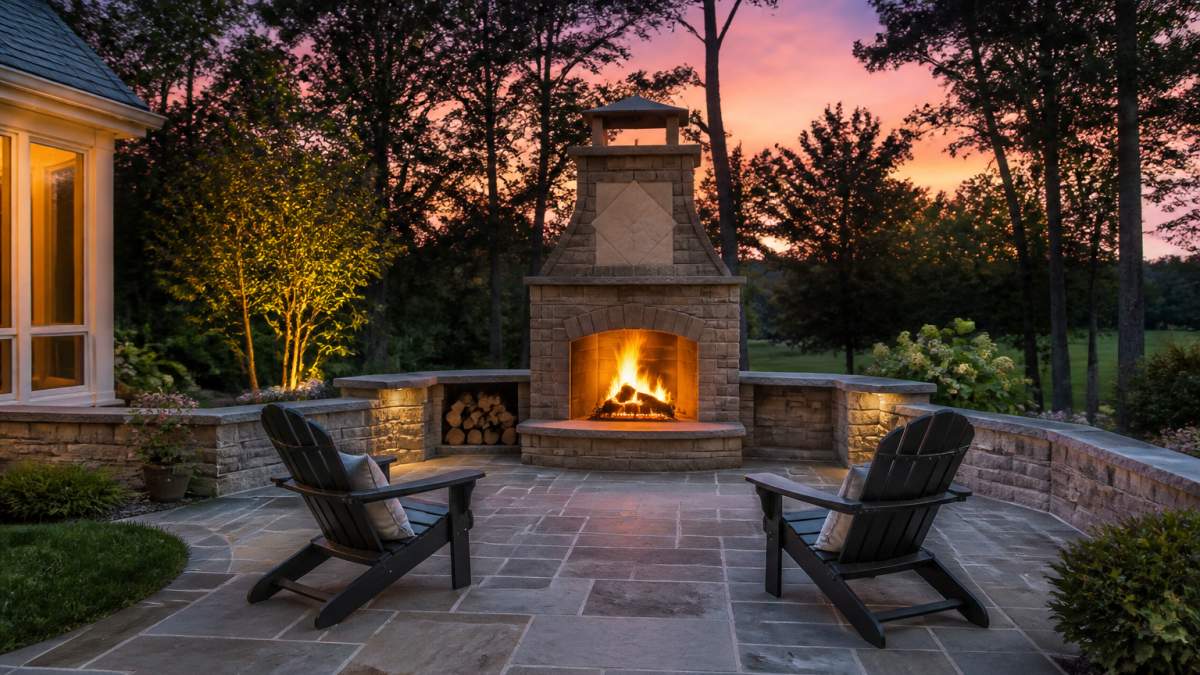
Patio Measurement and Placement Checklist
Use this as a planning checklist, then confirm every number against the manufacturer's installation manual for the specific unit:
- Wall width: the fireplace width plus clearance on both sides. A unit centered on a wall with no side clearance looks crammed.
- Hearth-to-seating distance: close enough to feel radiant heat, far enough that guests aren't dodging sparks or heat. Test with chairs before you commit.
- Circulation path: keep a clear walking route between the fire and the door, grill, or steps. A fireplace in the traffic lane gets avoided, not enjoyed.
- Overhead clearance: confirm the unit's venting and clearance requirements against any roof, pergola, or soffit above it. A fireplace tucked under a low roof needs a venting review.
- Clearance to combustibles: the manufacturer's stated clearance to combustible materials is a minimum, not a suggestion. This includes walls, trim, and nearby landscaping.
- Service access: leave room to reach the firebox, controls, and chimney for cleaning and service.
Patio Surface Compatibility and Load Requirements
| Surface | Weight and Structure | Heat and Spark Considerations |
|---|---|---|
| Concrete slab | Generally the most forgiving base for heavy units | Confirm the slab is sound and level; heat can stain or crack poorly cured concrete |
| Pavers | Good base if properly compacted and edged | Sparks and ash can scorch or stain; use a noncombustible pad under wood burners |
| Wood decking | Needs a structural review for point loads | Requires a fireproof pad and strict clearance from combustibles |
| Stone or tile | Solid but check the substrate beneath | Heat and thermal shock can affect some tiles; confirm suitability |
Smoke, Wind Direction, and Accessibility
Smoke follows the wind. Site the firebox so prevailing breezes push smoke away from seating and doors. Keep the unit accessible for cleaning and service, and never block the chimney's exhaust path. A fireplace tucked under a low roof needs careful venting review. Also think about neighbors: a wood-burning unit near a property line can send smoke where you don't want it, and local rules may apply.
Outdoor Fireplace Installation Requirements and Site Prep
A few prep steps worth locking down early:
If you're installing a wood-burning model, the correct fire stop accessory matters for safe clearance and venting. The Majestic Fire Stop for the Cottagewood Wood Fireplace is the matching part for that unit.
Matching the Fireplace to Your Patio's Design
A contemporary powder-coated unit reads clean and modern. A brick-lined wood burner reads traditional and warm. Pick the style that matches your home's exterior, not just the patio. Finish, surround material, and hearth shape all shape the final look.
Small patios benefit from a tighter footprint and a taller vertical line. Our small backyard patio design ideas show how a single focal feature can make a compact space feel intentional. If you want the patio to flow into the house, the seamless indoor-outdoor living guide covers how to tie the two spaces together.
Compare Outdoor Fireplaces for Your Patio
Here's a side-by-side look at four units, so you can compare type, fuel, and size for your patio.
| Model | Fuel | Sizes | Best For |
|---|---|---|---|
| Williams Outdoor Gas Fireplace | Natural gas or liquid propane | 72", 84", 96" | Contemporary patios, switch-on convenience |
| Majestic 42" Castlewood | Wood | 42" | Grand focal points, open-hearth drama |
| Majestic 42" Cottagewood | Wood | 42" | Freestanding or wall-mounted installs |
| Superior WRE3000 Series | Wood | 36", 42" | Patios and covered outdoor kitchens |
The Castlewood offers a 38" high firebox opening and stainless steel mesh screens for spark control. The Cottagewood includes a 20" protective hearth apron. The WRE3000 Series brings retractable mesh screens and a brushed stainless face.


Start with use, then narrow by fuel, then confirm size and clearances against your patio.
Frequently Asked Questions
How much space do you need around an outdoor fireplace?
Plan for open floor space in front of the firebox. Follow the manufacturer's stated clearances for your model.
Is a gas or wood-burning outdoor fireplace better for a patio?
The choice depends on the fuel configuration and features you want. The Williams Outdoor Gas Fireplace is available in natural gas or liquid propane configurations and with several ignition options. Wood-burning options include the Castlewood, Cottagewood, and WRE3000 Series.
Can you put an outdoor fireplace on a covered patio?
Check the specific unit's installation manual and applicable local requirements before deciding whether it suits your covered patio.
What should I check before installing an outdoor fireplace?
Confirm the unit's size, fuel configuration, and installation requirements in its product information and manufacturer's installation manual. Check applicable local requirements before installation.
Choosing an outdoor fireplace for a patio is a design decision and a safety decision at once. Get the use, fuel, and placement right, and the rest falls into place. Eternal Flame Outdoors carries premium fireplaces from trusted brands, with expert guidance to help you match the right unit to your layout. Our team can walk you through sizing, fuel options, and installation planning before you buy. Get started with Eternal Flame Outdoors and build a patio that draws people in all year.


Leave a comment
This site is protected by hCaptcha and the hCaptcha Privacy Policy and Terms of Service apply.