
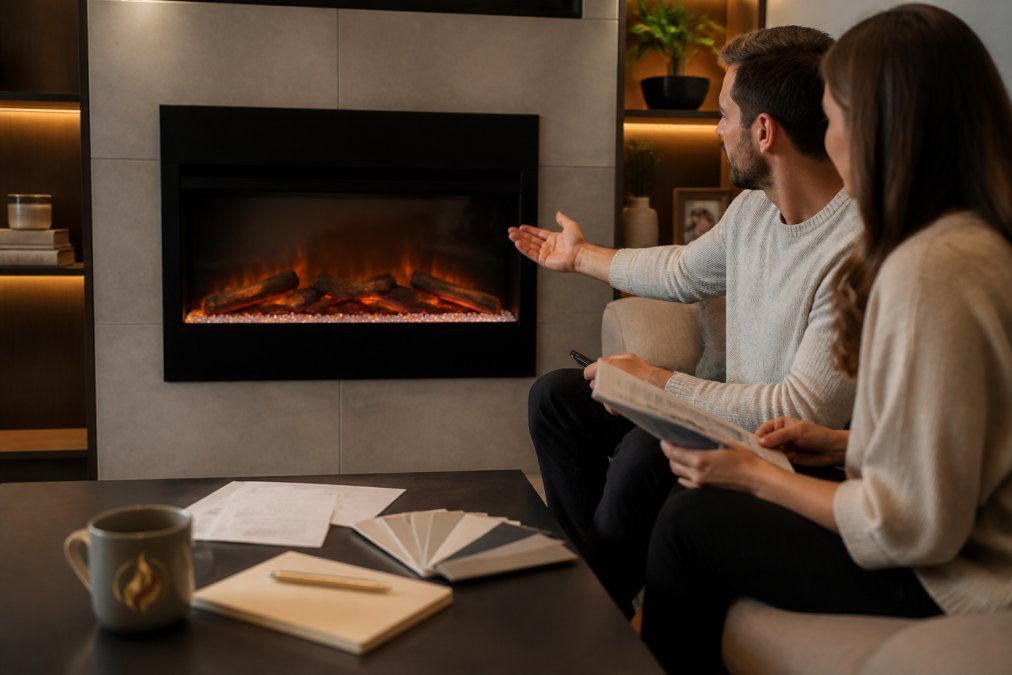
How to Choose Energy Efficient Electric Fireplace Options
Table of Contents
- What You'll Need Before You Shop
- Match BTU Output and Wattage to Your Room Size
- Electric Fireplace Wattage Usage: What It Costs to Run
- Electric Fireplace Thermostat Control and Timer Settings
- Electric Fireplace Zone Heating Benefits for Your Home
- Installation Requirements and Safety Certifications to Verify
- Maintenance Habits That Protect Heating Efficiency
- Conclusion
- Frequently Asked Questions
Last Updated: September 16, 2026
What You'll Need Before You Shop
Choosing an energy efficient electric fireplace starts with three numbers: your room's square footage, the BTU output the unit delivers, and the wattage it draws. Get those three aligned and you avoid the most common mistake buyers make, which is purchasing a fireplace that heats a space it was never sized for.
A 1,500-watt heater running four hours a night consumes meaningfully more electricity than a 750-watt unit doing the same job in a smaller room.
Before you shop, gather:
- Room dimensions and ceiling height
- Existing insulation quality (older windows and uninsulated walls change the math)
- Your electrical panel capacity and available outlet locations
- Whether you want supplemental heat or ambiance only
- Placement type: built-in, wall-mount, or freestanding
The U.S.
Match BTU Output and Wattage to Your Room Size
A general rule many installers use: roughly 10 watts of heating power per square foot of well-insulated space. A 1,500-watt fireplace suits a room up to about 150 square feet as a primary heat source, or a much larger room as supplemental warmth.
| Room Size | Suggested Wattage | Typical BTU Output | Best Use |
|---|---|---|---|
| Under 150 sq ft | 750W | ~2,500 BTU | Bedroom, office |
| 150-400 sq ft | 1,500W | ~5,000 BTU | Living room supplemental |
| 400-1,000 sq ft | 1,500W+ | 5,000-9,000 BTU | Open-plan zonal heating |
Electric Fireplace Wattage Usage: What It Costs to Run
Watts × hours used ÷ 1,000 = kWh, then kWh × your rate = cost
Worked Example: 1,500 Watts, Four Hours
A 1,500-watt fireplace run for four hours at full draw consumes 6 kWh. At 12 cents per kWh, that is about 72 cents for the evening. At 16 cents per kWh, it is about 96 cents. At 22 cents per kWh, common in parts of the Northeast and California, it is about $1.32.
| Utility Rate | 750W × 4 hrs (3 kWh) | 1,500W × 4 hrs (6 kWh) |
|---|---|---|
| 12¢ / kWh | ~36¢ | ~72¢ |
| 16¢ / kWh | ~48¢ | ~96¢ |
| 22¢ / kWh | ~66¢ | ~$1.32 |
Why the Real Number Is Usually Lower
Most electric fireplaces with a thermostat do not pull full wattage for the entire session. Once the room reaches the set temperature, the heater element cycles off while the fan and flame effect continue drawing a small fraction of the rated load. In a well-insulated room, a 1,500-watt unit might average 40-60% of its rated draw over a multi-hour session. In a drafty room, it may run near-continuous.
Reading the Kilowatt-Hour Label
Your utility bill states your rate in cents per kilowatt-hour. That single number is all you need. If your rate is 14 cents per kWh and you run a 1,500-watt heater three hours nightly, you are using 4.5 kWh per day, or roughly 63 cents. Over a month, that lands in the range of a couple of streaming subscriptions, not a second mortgage.
Comparing Against Other Heat Sources
Many units also include an energy-saving mode that cycles the heater on and off once the room reaches your set temperature, which cuts consumption further.
Electric Fireplace Thermostat Control and Timer Settings
Look for these controls when comparing models:
- Adjustable thermostat with a clear temperature range
- Timer settings that shut the unit off after a set period
- Flame-only mode so you get ambiance without heat in summer
- Remote control for convenient adjustment without getting up
The Dimplex Revillusion 24" Deluxe Built-In Firebox includes a remote and lets the flame effect run independently from the heater, so you can enjoy the look year-round without paying to heat a room you are not using.

Electric Fireplace Zone Heating Benefits for Your Home
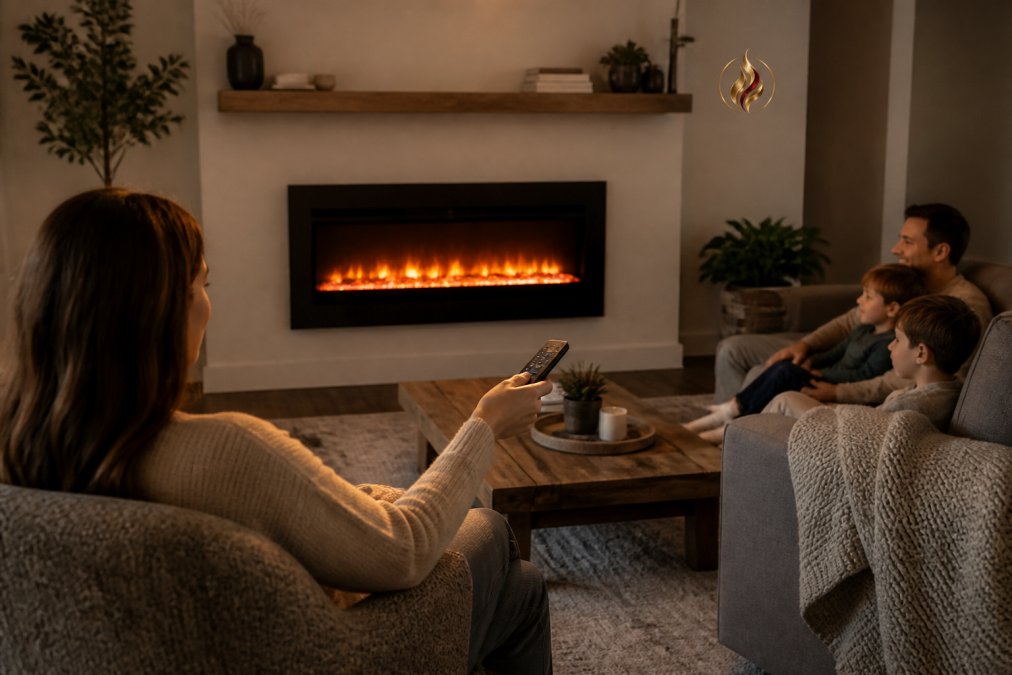
Electric fireplace zone heating benefits come down to one principle: heat the room you are in, not the whole house. Instead of raising the temperature on your central system and warming empty bedrooms, you run a single fireplace in the occupied space and lower the main thermostat.
The Setback Rule
Lower your central thermostat by two to three degrees below its normal daytime target, then set the fireplace thermostat two to three degrees above that new central target. The fireplace becomes the first system to satisfy the room, and the central system only kicks in if the fireplace cannot keep up. If you set the fireplace below the central target, the central system runs first and the fireplace adds nothing, you have simply added load.
Dimplex Multi-Fire XHD Plug in Electric →
Choosing the Right Zone
Zonal heating works best when one or two rooms carry most of the household's waking hours. Good candidates share three traits:
- Closed or semi-closed, a door you can close, or a room that does not open directly into a stairwell
- Well-insulated, newer windows, no obvious drafts
- Occupied for blocks of time, a living room used from 6 to 10 p.m., not a hallway
Supplemental Heat vs. Whole-Home Heating
Supplemental heat means the fireplace assists your existing system rather than replacing it. Whole-home heating pushes conditioned air through every duct in the house. For most households, the fireplace is the supplemental option, and that is exactly where the savings live. The savings come from the central system running less, not from the fireplace being cheaper per BTU than every alternative.
When Zonal Heating Does Not Pay Off
Be honest about the limits. If your central system is a modern heat pump running at high efficiency, the cost per delivered BTU may already be lower than resistance heating. In that case, zone heating is a comfort strategy, you get warmth in the room you are in, faster, not necessarily a cost strategy. If your home has one thermostat controlling the whole floor and no way to isolate rooms, the fireplace still helps, but the savings are smaller.
Installation Requirements and Safety Certifications to Verify
Installation requirements vary by unit type, and getting them wrong is the fastest way to void a warranty. Built-in fireboxes need framed openings with exact dimensions. Wall-mount and freestanding units need clearance from combustibles and a dedicated circuit in many cases.
Before you buy, confirm:
- Voltage requirements: most plug-in units run on standard 120V; larger built-ins may support 240V for higher output
- Circuit capacity: a 1,500-watt heater pulls about 12.5 amps, so avoid sharing the circuit with other high-draw appliances
- Clearance specifications from the manufacturer for your specific model
- Safety certifications such as a recognized listing mark on the unit
Maintenance Habits That Protect Heating Efficiency
Electric fireplace maintenance is minimal compared with wood or gas, but neglect still costs you. Dust accumulating on the heater element and fan forces the unit to work harder and can shorten its life.
A simple routine keeps heating performance steady:
- Vacuum the intake and exhaust vents every few weeks during heavy use
- Wipe the glass and flame panel with a soft, dry cloth
- Check the cord and plug for wear
- Keep the area around the unit clear of obstructions
Common Mistakes That Waste Energy
A third mistake is treating the fireplace as a primary heat source for a whole floor. It is designed for the room it sits in. Expecting more leads to disappointment and higher bills.
Conclusion
The gap between an efficient electric fireplace and an expensive one usually comes down to sizing and settings, not price tag. Match wattage to square footage, use the thermostat and timer, clean the vents, and lean on zone heating instead of warming rooms nobody is using.
Frequently Asked Questions
Are electric fireplaces actually energy efficient?
Yes, when used as supplemental heat rather than a primary source. Electric fireplaces convert nearly all the electricity they draw into heat, and flame-only mode uses a fraction of the power since the heater is off. Running a 1,500-watt unit at full heat for one hour uses about 1.5 kilowatt-hours. The efficiency comes from how you use it: zone heating one room instead of warming the whole house, and relying on the programmable thermostat to cycle the heater on and off.
How much electricity does an electric fireplace use per hour?
Most full-size electric fireplaces draw up to 1,500 watts on a 120V circuit, which equals roughly 1.5 kilowatt-hours per hour at maximum heat. Many models offer lower wattage settings, and flame-only operation drops consumption dramatically because the fan-forced heater stays off. To estimate your cost, multiply the kilowatt-hours used by your local electricity rate. A unit running at half heat for two hours uses far less than one running at full output all evening.
What features make an electric fireplace more energy efficient?
Look for a programmable thermostat, adjustable wattage or heat output settings, a timer, and flame-only mode. A thermostat lets the unit cycle off once the room reaches your target temperature instead of running continuously. Timer settings prevent overnight waste, and flame-only mode gives you ambiance without paying for heat. LED flame technology also draws very little power compared to the heating element, so you can enjoy the look of a fire without the energy cost.
Do electric fireplaces provide enough heat for a room?
It depends on the room and the model. A 1,500-watt unit producing around 5,100 BTUs can serve as supplemental heat for a space up to roughly 400 square feet, while some models with a 240V connection reach up to 9,212 BTUs and cover up to 1,000 square feet. For an open floor plan or a poorly insulated room, treat the fireplace as a supplement to your main heating system rather than a replacement, and size the BTU output to the room you actually want to warm.

Leave a comment
This site is protected by hCaptcha and the hCaptcha Privacy Policy and Terms of Service apply.