
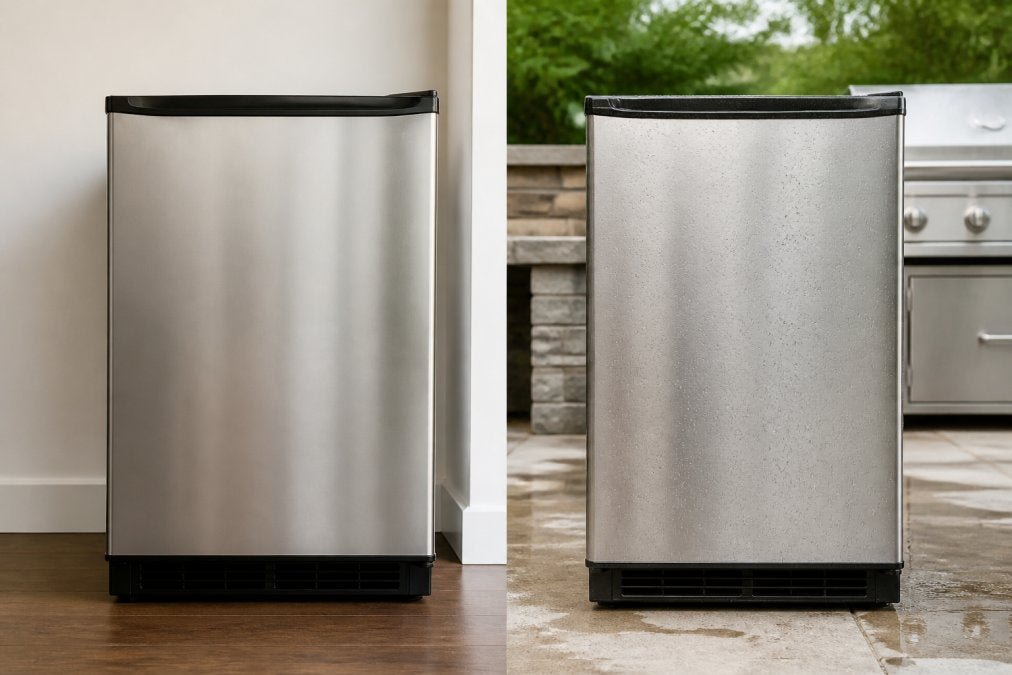
Indoor vs Outdoor Rated Refrigerators: Key Differences
Table of Contents
- Indoor vs Outdoor Rated Refrigerators: Comparison Table at a Glance
- How Ambient Temperature Ranges and Climate Class Separate Indoor and Outdoor Rated Refrigerators
- Insulation, Compressor Performance, and Thermal Regulation in Extreme Weather
- Moisture Resistance, UV Exposure, and Corrosion Prevention for Lasting Durability
- Outdoor Kitchen Refrigerator Requirements: Built-In vs Freestanding, Ventilation, and Seal Integrity
- UL-Rated Outdoor Appliances and Electrical Safety Codes You Need to Know
- Maintaining Outdoor Kitchen Appliances Through Every Season
- Conclusion: Choosing the Right Refrigerator for Your Outdoor Space
- Frequently Asked Questions
Last Updated: September 10, 2026
Indoor vs Outdoor Rated Refrigerators: Comparison Table at a Glance
The difference between indoor and outdoor rated refrigerators comes down to how each handles heat, humidity, and power. An outdoor rated refrigerator has a sealed compressor compartment, corrosion-resistant materials, and a wider operating temperature range than an indoor model. An indoor unit installed on a patio will fail early.
Here is how the two categories compare on the specs that actually matter:
| Feature | Indoor Rated | Outdoor Rated |
|---|---|---|
| Ambient temperature range | Narrow, typically 60-90°F | Wider, engineered for 0-110°F swings |
| Cabinet and hardware | Painted steel, plastic trim | Stainless steel, sealed fasteners |
| Moisture and humidity | Not protected | Sealed gaskets, drainage channels |
| UV exposure | Not rated | UV-stable exterior finish |
| Ventilation | Front or rear, indoor air | Front-venting, sealed compressor compartment |
| Electrical protection | Standard outlet | GFCI-protected dedicated circuit recommended |
| Warranty coverage | Void if installed outdoors | Covers outdoor installation |
That table is the short answer. The rest of this guide explains why each row exists, so you can evaluate a spec sheet instead of trusting a label.
How Ambient Temperature Ranges and Climate Class Separate Indoor and Outdoor Rated Refrigerators
An outdoor rated refrigerator is tested to hold temperature across a much wider ambient range than an indoor model, the single biggest technical divider between the two. The clearest way to compare units is their climate class, a standardized rating of the ambient range the appliance is designed for.
An indoor refrigerator assumes a climate-controlled room, with a compressor and condenser sized for stable air between roughly 60°F and 90°F. Move that unit onto a patio in July, where the air may sit above 100°F, and the compressor runs almost continuously trying to reject heat into already-hot air. It overheats, short-cycles, and eventually quits.
Outdoor units are built for the opposite condition: compressor, condenser, and controls are designed to hold food-safe interior temperatures through summer heat and winter cold.
Climate Class Ratings Explained
Climate class is the spec most shoppers skip and most spec sheets bury. Defined by the same international standard that governs household refrigerating appliances, it sorts units into four bands by the ambient temperature they are engineered to handle:
| Climate Class | Ambient Temperature Range | Typical Use Case |
|---|---|---|
| SN (Subnormal) | 50°F to 90°F | Cooler climates, extended-range indoor units |
| N (Normal) | 61°F to 90°F | Standard indoor kitchens |
| ST (Subtropical) | 61°F to 100°F | Warmer rooms, light outdoor use |
| T (Tropical) | 61°F to 109°F | Hot climates, demanding outdoor installations |
A higher climate class means the unit tolerates more extreme surroundings. Where summer afternoons routinely push past 100°F, a class N unit is already outside its design envelope before you factor in direct sun on a stainless steel door. A class T unit is built for that condition.
The practical takeaway: climate class is not a marketing label but a tested operating range. When a spec sheet lists a class, compare it directly against your local summer highs and winter lows. When it does not list one, treat the omission as a red flag.
Why Temperature Fluctuation Matters as Much as the Peak
Temperature fluctuations matter as much as the peak. A unit facing 40°F mornings and 100°F afternoons must regulate constantly, cycling the compressor as ambient air swings. Outdoor-rated refrigeration is engineered for that cycling; indoor units are not. Their thermostat, compressor duty cycle, and insulation are sized for a narrower band, which is why an indoor unit asked to hold temperature through a 60-degree daily swing will short-cycle and wear out its compressor years early.
Insulation, Compressor Performance, and Thermal Regulation in Extreme Weather
Compressor performance in extreme weather is where cheap outdoor refrigerators reveal themselves. The compressor must move heat out of the cabinet while sitting in hot, dirty, sometimes humid air.
Three construction details separate a unit that lasts from one that does not:
- Insulation thickness. Better cabinet insulation means the compressor works less to hold temperature, which extends its life and reduces overheating risk.
- Condenser and evaporator design. Corrosion-resistant coils shed heat efficiently and resist the moisture that degrades unprotected metal.
- Seal integrity. Door gaskets that stay pliable in heat and cold keep warm, humid air out. A failing seal forces the compressor to run harder.
Thermal bridging is a related problem: heat traveling through the cabinet's frame and fasteners rather than through insulation. Stainless steel construction with sealed, insulated joints limits it; thin-gauge cabinets with exposed metal framing invite it.
IP Ratings Explained: What the Numbers Actually Mean
An IP rating is a two-digit standard for how well an enclosure keeps out solid objects and water. The first digit covers dust and debris; the second covers water. An IPX4 rating, for example, means the unit tolerates splashing water, and a higher second digit means greater water resistance.
For an outdoor kitchen refrigerator, a higher IP rating signals better protection against rain, hose spray, and humid air. It is a measurable enclosure standard, and when two units look identical, it is often the real difference.
Energy Star, Climate Class, and Real Energy Efficiency Comparisons
Energy Star is a government-backed efficiency certification, and it matters more outdoors than indoors. A unit that runs efficiently in a climate-controlled room can become an energy hog on a patio, because a struggling compressor draws far more power than an efficient one.
Compare efficiency by looking at three things together: the Energy Star rating, the climate class, and the stated ambient operating range. A refrigerator rated for a wide ambient range and carrying Energy Star certification will generally cost less to run outdoors than an uncertified unit that fights the heat. Efficiency and durability are linked; the unit that runs less lasts longer.
Moisture Resistance, UV Exposure, and Corrosion Prevention for Lasting Durability
Corrosion prevention is the difference between an outdoor refrigerator that looks new after five summers and one that shows rust streaks after two. Humidity, rain, and salt air attack every exposed surface, and UV exposure breaks down finishes and plastics not stabilized for sunlight.
What to look for:
- Stainless steel construction, ideally with a grade suited to outdoor exposure
- UV-stable exterior finishes that will not chalk or fade
- Sealed fasteners and hardware that resist galvanic corrosion
- Drainage channels that move water away from the cabinet and door frame
A common mistake is assuming "stainless" means rust-proof. Lower-grade stainless can still corrode in coastal or high-humidity environments. Durability comes from the combination of material grade, finish, and sealed assembly, not any single feature.
Outdoor Kitchen Refrigerator Requirements: Built-In vs Freestanding, Ventilation, and Seal Integrity
Outdoor kitchen refrigerator requirements start with ventilation. A built-in unit needs front-venting so the compressor can breathe through the cabinet face, while a freestanding unit vents from its back and sides and needs clearance around it.
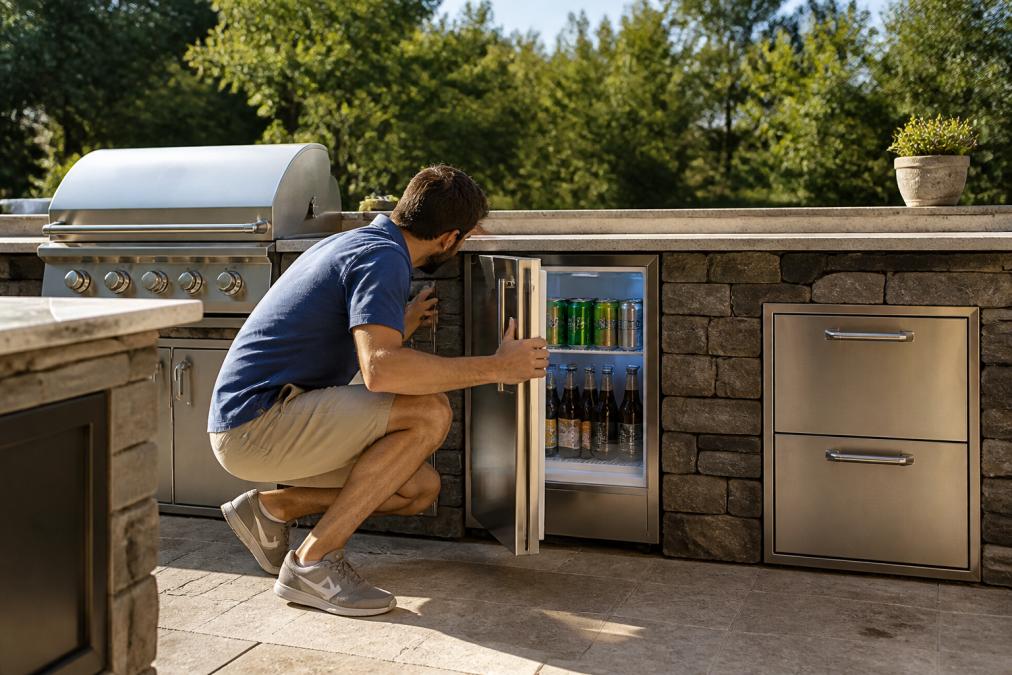
Built-in models sit flush inside cabinetry and give a finished outdoor kitchen the cleaner look. Freestanding models are more flexible and easier to reposition, but need open space behind and beside them.
Ventilation is not optional. Trap a built-in unit in a sealed cabinet without a front vent and you recreate the overheating problem outdoor units are designed to avoid. Seal integrity ties in here too: a door gasket that stays flexible in heat keeps humid air out, while a stiff or cracked seal lets it in.
U.S. Department of Energy guidance on appliance energy use
UL-Rated Outdoor Appliances and Electrical Safety Codes You Need to Know
UL-rated outdoor appliances carry a safety certification from Underwriters Laboratories, an independent testing organization. That listing tells you the unit has been evaluated for the conditions it is sold for, including outdoor electrical exposure. Look for the UL mark on the data plate, not just in the marketing copy.
For any refrigerator installed outdoors, electrical safety codes matter as much as the appliance itself. This is the part of the project most homeowners underestimate, because the outlet is usually an afterthought behind the cabinetry. Get it wrong and you create a shock hazard and a code violation that must be corrected after the stone is set.
GFCI Protection: What the Code Actually Requires
A ground-fault circuit interrupter cuts power within a fraction of a second when it detects current leaking to ground, the condition that causes shock in wet locations. The National Electrical Code requires GFCI protection for receptacles installed outdoors, including those serving outdoor kitchen appliances, because a standard indoor outlet offers no ground-fault protection and a wet patio is exactly where a fault becomes dangerous.
Two practical points follow from that:
- The GFCI can be at the breaker or at the receptacle. A GFCI breaker protects the whole circuit; a GFCI receptacle protects everything downstream of it. Either satisfies the requirement, but a GFCI breaker is often the cleaner choice for a dedicated outdoor kitchen circuit because it is easier to reset indoors.
- A GFCI does not replace a proper enclosure. The receptacle still needs a weather-resistant cover rated for wet locations, and the box needs to be rated for outdoor use. A GFCI in an indoor-rated box is still a code problem.
Dedicated Circuits and Why They Matter
A dedicated circuit means the refrigerator is the only load on that breaker. Outdoor refrigerators should run on their own circuit rather than sharing with a grill, an ice maker, or lighting. The reason is not just code but performance: when a refrigerator shares a circuit with a high-draw appliance, voltage sags every time the other appliance cycles on, and the compressor feels it. Nuisance tripping is the visible symptom; shortened compressor life is the hidden one.
Size the circuit to the unit's rated draw, and confirm the amperage with your electrician before the cabinet is built. Most residential outdoor refrigerators draw well under the capacity of a standard 15- or 20-amp circuit, but the circuit still needs to be dedicated and protected.
Plan the Electrical During Design, Not After
Installation requirements vary by local code, and local amendments can be stricter than the model code, so confirm the specifics with your electrician before the cabinet is built. Planning the circuit, outlet location, and GFCI device during design is far easier than retrofitting them once stone and cabinetry are in place.
Electrical safety information from the U.S. Consumer Product Safety Commission
Maintaining Outdoor Kitchen Appliances Through Every Season
Maintaining outdoor kitchen appliances comes down to a simple routine that keeps moisture, debris, and heat stress from shortening their life.
- Clean condenser coils regularly so the compressor is not fighting restricted airflow.
- Inspect door gaskets each season and replace any that stiffen or crack.
- Wipe down exterior surfaces to remove residue that traps moisture against the finish.
- Check the outlet and cord for wear, especially after winter.
- Cover or shelter the unit during prolonged cold or storm seasons if the manufacturer recommends it.
A common mistake is treating outdoor appliances like indoor ones and skipping seasonal checks. The units that last get a few minutes of attention twice a year. For guidance on what fits your space and climate, the team at Eternal Flame Outdoors can help you plan the layout and select equipment built for your conditions.
Conclusion: Choosing the Right Refrigerator for Your Outdoor Space
The choice is not between two similar products but between a unit engineered for a climate-controlled room and one engineered for sun, rain, and temperature swings. Matching the appliance to its environment protects your investment and keeps food safe.
Eternal Flame Outdoors helps homeowners, designers, and builders plan complete outdoor kitchens, from layout and ventilation to appliance selection, with authorized brands and products backed by trusted warranties. Explore our outdoor kitchen collection or contact us for personalized guidance on the right refrigeration and equipment for your space.
Frequently Asked Questions
Can an indoor refrigerator be used outdoors?
An indoor refrigerator can be placed outdoors, but it will not perform reliably or last long. Indoor models lack the insulation, weatherproofing, and corrosion-resistant components needed for outdoor conditions. Humidity, UV exposure, and temperature fluctuations cause the compressor to overheat and the cabinet to rust. Using an indoor fridge outside typically voids the warranty and leads to costly underperformance within a season or two.
What makes a refrigerator outdoor rated versus indoor?
Outdoor rated refrigerators are built with a climate class that handles higher ambient temperatures, usually up to 110°F or more. They use thicker insulation, sealed and corrosion-resistant stainless steel, UV-stable finishes, and UL-rated components for wet locations. Indoor models are designed for stable room temperatures and lack these protections. The UL listing and IP rating on the label tell you exactly which environment the unit is approved for.
What happens if you put an indoor fridge in an outdoor kitchen?
An indoor fridge in an outdoor kitchen will struggle to hold temperature as the compressor runs constantly in summer heat. Moisture and humidity corrode the evaporator and condenser coils, and the exterior finish fades or peels from UV exposure. Seal integrity fails, letting warm, humid air inside. Over time, the unit underperforms, overheats, and often breaks down well before its expected lifespan. The warranty is also voided.
Is an outdoor refrigerator worth the extra investment?
For an outdoor kitchen, an outdoor rated refrigerator is worth the investment because it is engineered for the conditions it will face. It maintains temperature in extreme heat, resists corrosion and moisture, and carries a UL rating for safe outdoor use. It also keeps its warranty intact. An indoor model used outside will likely need replacing far sooner, so the upfront savings rarely hold up over time.
The hardest part of an outdoor kitchen build is not choosing a refrigerator; it is coordinating ventilation, electrical, and cabinetry so the appliance can actually perform. Eternal Flame Outdoors handles that planning with you, offering expert guidance, a curated selection of premium outdoor living products, and nationwide delivery backed by trusted warranties. Get started with Eternal Flame Outdoors and build an outdoor kitchen that performs as well as it looks.

Leave a comment
This site is protected by hCaptcha and the hCaptcha Privacy Policy and Terms of Service apply.